Chargers vs New England Patriots: Drake Maye Outduels Justin Herbert as Patriots Advance in AFC Wild Card
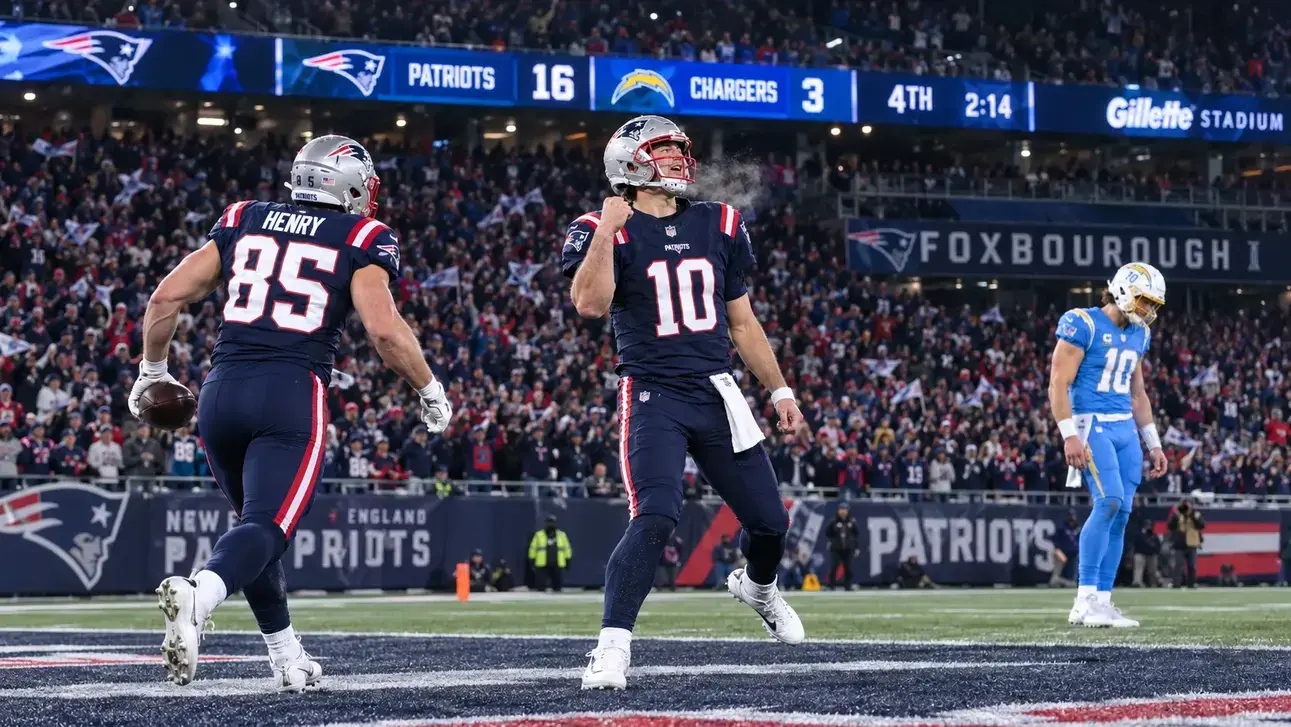
The Chargers vs New England Patriots wild-card showdown was never going to be a shootout. What unfolded at Gillette Stadium was a brutal, defensive slugfest where every yard was contested and every mistake felt magnified. When the final whistle blew, the scoreboard read 16-3 in favor of the home team—a result that exposed the Chargers’ red-zone failures and validated New England’s patient, big-play approach.
The game remained scoreless through the first quarter before Andy Borregales opened the scoring with a 23-yard field goal early in the second. Cameron Dicker answered with a 21-yard kick for Los Angeles, but Borregales added two more field goals before and after halftime to build a 9-3 cushion. The decisive blow came with 9:45 remaining in the fourth quarter, when Drake Maye found Hunter Henry for a 28-yard touchdown that sealed the Chargers vs New England Patriots outcome and ended Los Angeles’ season.
Match Overview Table
| Information | Match Details |
| Event | NFL AFC Wild Card Playoffs |
| Game | Los Angeles Chargers vs New England Patriots |
| Date | January 11, 2026 |
| Venue | Gillette Stadium, Foxborough, Massachusetts |
| Attendance | Not specified in available sources |
| Winner | New England Patriots |
| Final Score | 16-3 |
| Broadcast | NBC (Sunday Night Football) |
Core Match Statistics Overview
The Chargers vs New England Patriots box score reveals a lopsided picture in total production, even if the scoreline stayed relatively close until the fourth quarter.
| Metric | Chargers | Patriots |
| Total Yards | 207 | 381 |
| Yards per Play | 3.5 | 6.0 |
| Passing Yards | 120 | 235 |
| Rushing Yards | 87 | 146 |
| First Downs | 17 | 19 |
| Third Down Efficiency | 1-10 | 4-11 |
| Sacks Allowed | 6 | 5 |
| Turnovers | 1 | 2 |
| Time of Possession | 27:45 | 32:15 |
Total Yardage Gap
- The Patriots nearly doubled Los Angeles in total offense (381 to 207), with Maye consistently finding explosive gains through the air and on scrambles.
- The Chargers averaged just 3.5 yards per play, their lowest mark of the season, as Herbert was under siege all night.
Third Down Efficiency
- Los Angeles converted just 1 of 10 third-down attempts, a catastrophic failure that repeatedly stalled drives and kept the defense on the field.
- New England’s 4-for-11 rate was far from elite, but it extended key drives that produced points, including the fourth-quarter touchdown march.
Sack and Pressure Differential
- The Patriots sacked Herbert six times for 39 yards lost, with K’Lavon Chaisson’s strip-sack in the fourth quarter effectively ending any comeback hopes.
- Odafe Oweh recorded three sacks and two forced fumbles for Los Angeles, but the Chargers offense failed to convert either turnover into points.
Period-by-Period Analysis
First Quarter
| Team | Q1 Score |
| Chargers | 0 |
| Patriots | 0 |
Both defenses dominated early, with neither offense able to establish rhythm or cross midfield consistently.- The Chargers’ best opportunity came after Daiyan Henley intercepted Maye at the New England 10-yard line, but four plays netted zero points.
- New England’s opening drive consumed over six minutes but ended in a punt, setting the tone for a field-position battle.
Second Quarter
| Team | Q2 Score |
| Chargers | 3 |
| Patriots | 6 |
Borregales opened the scoring with a 23-yard field goal after a 14-play, 93-yard drive that took 6:40 off the clock.- Dicker answered with a 21-yard kick following an 11-play, 69-yard march, briefly tying the game at 3-3.
- Maye’s 37-yard scramble in the final minute set up Borregales’ 35-yard field goal as time expired, giving New England a 6-3 halftime lead.
Third Quarter
| Team | Q3 Score |
| Chargers | 0 |
| Patriots | 3 |
Oweh strip-sacked Maye in the red zone on New England’s opening drive, but Los Angeles punted after three plays, wasting the turnover.- The Patriots responded with a 39-yard Borregales field goal after a 42-yard completion to Kayshon Boutte moved them into scoring range.
- Los Angeles managed just two first downs in the quarter and punted on both possessions, losing the field-position battle decisively.
Fourth Quarter
| Team | Q4 Score |
| Chargers | 0 |
| Patriots | 7 |
Maye capped a 7-play, 80-yard drive with a precise 28-yard touchdown pass to Hunter Henry, extending the lead to 16-3.- Chaisson strip-sacked Herbert on the Chargers’ ensuing possession, recovering the fumble and ending any realistic comeback attempt.
- Herbert was sacked by Milton Williams on fourth down on Los Angeles’ final drive, sealing the Chargers vs New England Patriots result.
Detailed Team Player Statistics
Los Angeles Chargers Player Statistics
Justin Herbert, QB
| Metric | Value |
| Completions/Attempts | 19/31 |
| Passing Yards | 159 |
| Touchdowns | 0 |
| Interceptions | 0 |
| Passer Rating | 74.5 |
| Rushing Yards | 57 (team high) |
| Sacks Taken | 6 |
Herbert was under constant duress and never found a rhythm, averaging just 5.1 yards per attempt. He was the Chargers’ leading rusher by default as the pocket collapsed repeatedly, and his fourth-quarter fumble effectively ended the game.
Ladd McConkey, WR
| Metric | Value |
| Receptions | 3 |
| Targets | 4 |
| Receiving Yards | 32 |
| Long | 20 |
McConkey led a receiving corps that was almost entirely neutralized, as no Chargers pass-catcher exceeded 32 yards. His quick-game work was the only reliable outlet Herbert had all evening.
Keenan Allen, WR
| Metric | Value |
| Receptions | 3 |
| Targets | 8 |
| Receiving Yards | 25 |
Allen saw the most targets on the team but averaged just 8.3 yards per catch. The Patriots’ secondary bracketed him on critical downs, including the failed fourth-and-goal attempt in the first half.
Odafe Oweh, Edge Rusher
| Metric | Value |
| Sacks | 3 |
| Forced Fumbles | 2 |
| Tackles | 4 |
Oweh was the best player on the field for stretches, single-handedly generating pressure and turnovers. His strip-sack of Maye in the red zone should have changed the game, but the offense’s inability to capitalize wasted a generational defensive effort.
New England Patriots Player Statistics
Drake Maye, QB
| Metric | Value |
| Completions/Attempts | 17/29 |
| Passing Yards | 268 |
| Touchdowns | 1 |
| Interceptions | 1 |
| Passer Rating | 86.6 |
| Rushing Yards | 66 (team high) |
| Rushing Long | 37 |
Maye was the engine of New England’s offense, producing explosive plays with both his arm and legs. His 37-yard scramble before halftime flipped field position, and his 28-yard touchdown to Henry was the game’s only offensive score. The two turnovers were concerning, but his big-play ability more than compensated.
Rhamondre Stevenson, RB
| Metric | Value |
| Rushing Attempts | 10 |
| Rushing Yards | 53 |
| Receptions | 3 |
| Receiving Yards | 75 |
| Long Reception | 48 |
Stevenson was Maye’s most reliable check-down option, turning a short pass into a 48-yard gain that ignited New England’s first scoring drive. His 5.3 yards per carry gave the Chargers’ pass rush just the right amount of balance.
Kayshon Boutte, WR
| Metric | Value |
| Receptions | 4 |
| Targets | 4 |
| Receiving Yards | 66 |
| Long | 42 |
Boutte delivered the game’s most important non-scoring catch, a 42-yard grab that set up Borregales’ third field goal. He was perfect on his targets and consistently found soft spots in Los Angeles’ zone coverage.
Hunter Henry, TE
| Metric | Value |
| Receptions | 3 |
| Targets | 5 |
| Receiving Yards | 64 |
| Touchdowns | 1 |
Henry’s 28-yard touchdown reception was the dagger, as he beat coverage over the middle and ran untouched into the end zone. His 21.3 yards per catch led all Patriots receivers.
Statistical Leaders Summary Table
| Category | Chargers | Patriots |
| Leading Passer | Justin Herbert (159 yds, 0 TD, 0 INT) | Drake Maye (268 yds, 1 TD, 1 INT) |
| Leading Rusher | Justin Herbert (57 yds) | Drake Maye (66 yds) |
| Leading Receiver | Ladd McConkey (32 yds) | Rhamondre Stevenson (75 yds) |
| Top Defender | Odafe Oweh (3 sacks, 2 FF) | K’Lavon Chaisson (1 sack, 1 FF, 1 FR) |
| Kicker | Cameron Dicker (1/1 FG, 21 long) | Andy Borregales (3/3 FG, 39 long) |
Analytical Breakdowns
Why New England Won
### Explosive Play Generation
The Patriots generated five plays of 20 or more yards, accounting for 175 of their 381 total yards. Maye’s 37-yard scramble, Stevenson’s 48-yard catch-and-run, Boutte’s 42-yard reception, and Henry’s 28-yard touchdown each came at critical moments. Los Angeles, by contrast, managed just one play over 20 yards all evening.
| Explosive Play | Yards | Quarter | Result |
| Maye scramble | 37 | Q2 | Borregales FG |
| Stevenson reception | 48 | Q2 | Borregales FG |
| Boutte reception | 42 | Q3 | Borregales FG |
| Boutte reception | 16 | Q4 | Henry TD drive |
| Henry touchdown | 28 | Q4 | Touchdown |
### Red-Zone Efficiency When It Mattered
New England’s red-zone numbers were not impressive on paper (0-for-3 on touchdowns until the fourth quarter), but they converted when the game was on the line. The Patriots settled for three field goals on early trips but punched in the touchdown that created an insurmountable two-score gap. Los Angeles, meanwhile, went 0-for-2 in the red zone, including a failed fourth-and-goal from the 2-yard line in the first half.
### Defensive Front Dominance
The Patriots sacked Herbert six times and hit him repeatedly, forcing the Chargers into obvious passing situations where their pass rush could pin its ears back. Chaisson’s strip-sack in the fourth quarter was the defining defensive play of the Chargers vs New England Patriots matchup.
| Defensive Metric | Patriots | Chargers |
| Sacks | 6 | 5 |
| QB Hits | 8 | 6 |
| Forced Fumbles | 1 | 2 |
| Fumble Recoveries | 1 | 1 |
Why Los Angeles Lost
### Catastrophic Third-Down Failures
A 1-for-10 conversion rate on third down is not a recipe for winning playoff football. The Chargers repeatedly found themselves in third-and-long situations after early-down sacks or stuffed runs, and Herbert rarely had a clean pocket to convert. Five of their ten third-down attempts required seven or more yards.
### Wasted Defensive Takeaways
The Chargers forced two turnovers—an interception by Henley and a fumble recovery by Hand—and both came in New England territory. Neither produced a single point. The interception set up first-and-goal from the 10; four plays later, Herbert threw incomplete on fourth down. The fumble recovery in the red zone was followed by a three-and-out. Against a playoff defense, those missed opportunities are fatal.
### No Answers in the Passing Game
No Chargers receiver topped 32 yards, and Herbert averaged just 5.1 yards per attempt. The Patriots’ secondary, led by Christian Gonzalez before his second-half injury, blanketed McConkey, Allen, and Johnston. Herbert’s 74.5 passer rating was his fourth-lowest of the season, and his 159 passing yards were a season-worst in games he finished.
Historical Context & Advanced Insights
Season Series Breakdown
The Chargers vs New England Patriots wild-card meeting was the only matchup between these teams during the 2025 season. Their most recent prior meeting came during the 2024 regular season, when the Chargers won 40-7 in Foxborough. The Patriots’ victory avenged that embarrassment and marked their first playoff win since Super Bowl LIII following the 2018 season .
| Season | Result | Score | Context |
| 2025 (Playoffs) | Patriots win | 16-3 | AFC Wild Card |
| 2024 (Regular Season) | Chargers win | 40-7 | Week 17 |
Advanced Statistical Insights
The relationship between time of possession and outcome proved prophetic for Los Angeles. During the regular season, the Chargers finished first in the NFL in time of possession at 32:55 per game (excluding Week 18). They won the possession battle in 12 of 16 meaningful games, going 10-2 in those contests. Against New England, they held the ball for just 27:45—their second-lowest mark of the season—and their offense managed only three points .
The assist-to-field-goal ratio tells another story: New England kicked three field goals but also scored the game’s only touchdown, while Los Angeles kicked one field goal and never reached the end zone. In a game where both defenses dominated, the team that could produce one moment of offensive brilliance—Maye to Henry—won.
Game Implications & Key Lessons
What This Means for New England
- The Patriots advance to the divisional round, where they will host the winner of the Steelers-Texans wild-card matchup. Their defense proved capable of winning a playoff game without gaudy offensive numbers.
- Drake Maye’s first career playoff start was uneven but winning: 268 total yards, one touchdown, and two turnovers that his defense bailed him out of. The experience of winning a tight, ugly game is invaluable for a young quarterback.
- New England’s pass rush generated six sacks without needing to blitz heavily, suggesting the front four can dictate terms against elite quarterbacks.
What This Means for Los Angeles
- The Chargers’ season ends in the wild-card round for the second consecutive year, and Justin Herbert falls to 0-3 in his playoff career. The narrative around his postseason performance will only intensify after a 159-yard, zero-touchdown outing.
- Jim Harbaugh’s offense must address its red-zone inefficiency and third-down conversion problems. A 1-for-10 mark is unacceptable at any level, let alone in a playoff game.
- Odafe Oweh’s breakout performance (3 sacks, 2 forced fumbles) is a silver lining, but the defense’s excellent effort was wasted by an offense that could not score.
Key Lessons
- Turnovers only matter if you score. The Chargers forced two turnovers in New England territory and came away with zero points.
- Third down is the money down. A 10% conversion rate will lose nearly every game, regardless of defensive performance.
- Explosive plays beat methodical drives in low-scoring games. New England’s five 20-plus-yard gains produced all 16 points; Los Angeles’ dink-and-dunk approach produced three.
- A mobile quarterback changes everything. Maye’s 66 rushing yards, including the 37-yard scramble, extended drives that field goals ultimately capped.
- Red-zone execution separates winners from losers. New England scored a touchdown on one of four red-zone trips; Los Angeles scored zero on two.
Conclusion
The Chargers vs New England Patriots wild-card game was decided by the smallest margins in the biggest moments. New England generated explosive plays when Los Angeles could not, converted red-zone opportunities when the Chargers stalled, and protected a lead with a ferocious pass rush that battered Justin Herbert from start to finish. Odafe Oweh’s three-sack performance kept the Chargers within striking distance, but an offense that converted 1 of 10 third downs and scored zero touchdowns on two red-zone trips never deserved to win. Drake Maye’s legs and one perfect throw to Hunter Henry were enough. In January football, that is often all it takes.