Colts vs Atlanta Falcons Match Player Stats: Jonathan Taylor Leads Indianapolis to Overtime Victory
Fans searching for the full colts vs atlanta falcons match player stats usually want one thing fast: who carried the offense, and who folded under pressure. This Week 10 clash in Berlin had both. Indianapolis needed overtime to shake off a late Atlanta rally, and one running back turned a tight game into a historic afternoon. Below is the complete statistical breakdown, player by player.
The Lead
The Indianapolis Colts beat the Atlanta Falcons 31-25 in overtime on Sunday, November 9, 2025, in the first regular-season NFL game ever played in Berlin. The contest was held at Olympiastadion in front of <cite index=”15-1″>72,203 fans</cite>, with Clete Blakeman serving as referee and NFL Network carrying the broadcast.
Indianapolis built an early cushion behind explosive offense, only to watch Atlanta claw back with a fourth-quarter surge that put the Falcons ahead 25-22 in the closing minutes.
A late field goal forced overtime, and Jonathan Taylor settled the issue himself, capping a career day with the game-winning touchdown run. Daniel Jones moved the ball efficiently through the air for Indianapolis, while Michael Penix Jr. kept Atlanta within striking distance until the final whistle.
Match Overview
| Information | Match Details |
| Event | NFL Week 10, 2025 Regular Season |
| Game | Atlanta Falcons vs Indianapolis Colts |
| Date | Sunday, November 9, 2025 |
| Venue | Olympiastadion, Berlin, Germany |
| Attendance | 72,203 |
| Winner | Indianapolis Colts |
| Final Score | Colts 31, Falcons 25 (OT) |
| Broadcast | NFL Network |
Core Match Statistics Overview
The gap in this game shows up clearly once you line up the team totals side by side.
| Team Stat | Atlanta Falcons | Indianapolis Colts |
| Total Yards | 290 | 519 |
| Total Plays | 60 | 74 |
| Yards Per Play | 4.8 | 7.0 |
| Passing Yards | 150 | 196 |
| Yards Per Pass | 5.4 | 7.5 |
| Rushing Yards | 140 | 323 |
| Rush Average | — | 7.9 |
| Turnovers | 1 | 2 |
| Time of Possession | 26:09 | 40:20 |
Rushing Production
- Indianapolis piled up 323 rushing yards on the day, more than double Atlanta’s rushing total, and that gap decided the game before the fourth quarter even started.
- Jonathan Taylor alone out-gained the entire Falcons rushing attack by more than 100 yards.
Time of Possession and Tempo
- The Colts held the ball for over 40 minutes, a direct result of long, sustained drives built around the ground game.
- Atlanta’s offense touched the ball on only 60 plays, leaving Penix fewer opportunities to extend drives through the air.
Passing Efficiency
- Daniel Jones posted a 100.6 passer rating on 19-of-26 throwing, a far more efficient day than Penix’s 76 rating on 12-of-28.
- Both quarterbacks threw for a touchdown, but Jones did it with fewer attempts and a better completion rate.
Turnover Margin
- Indianapolis forced two turnovers compared to one, a small but meaningful edge in a game decided by four points.
- Atlanta’s lone giveaway came at a costly moment, feeding directly into Colts scoring chances.
Period-by-Period Analysis
| Quarter | ATL | IND |
| 1st | 7 | 13 |
| 2nd | 7 | 0 |
| 3rd | 3 | 0 |
| 4th | 8 | 12 |
| OT | 0 | 6 |
| Final | 25 | 31 |
- Indianapolis came out fast, scoring 13 first-quarter points behind explosive plays that Atlanta’s defense had allowed at a season-high rate through the opening period.
- Atlanta answered with 10 unanswered points across the second and third quarters, trimming what had briefly looked like a runaway Colts lead.
- The fourth quarter turned into a shootout: Atlanta scored eight points, including a go-ahead one-yard touchdown run from Tyler Allgeier, before Indianapolis answered with a field goal to force overtime.
Indianapolis Colts Player Statistics
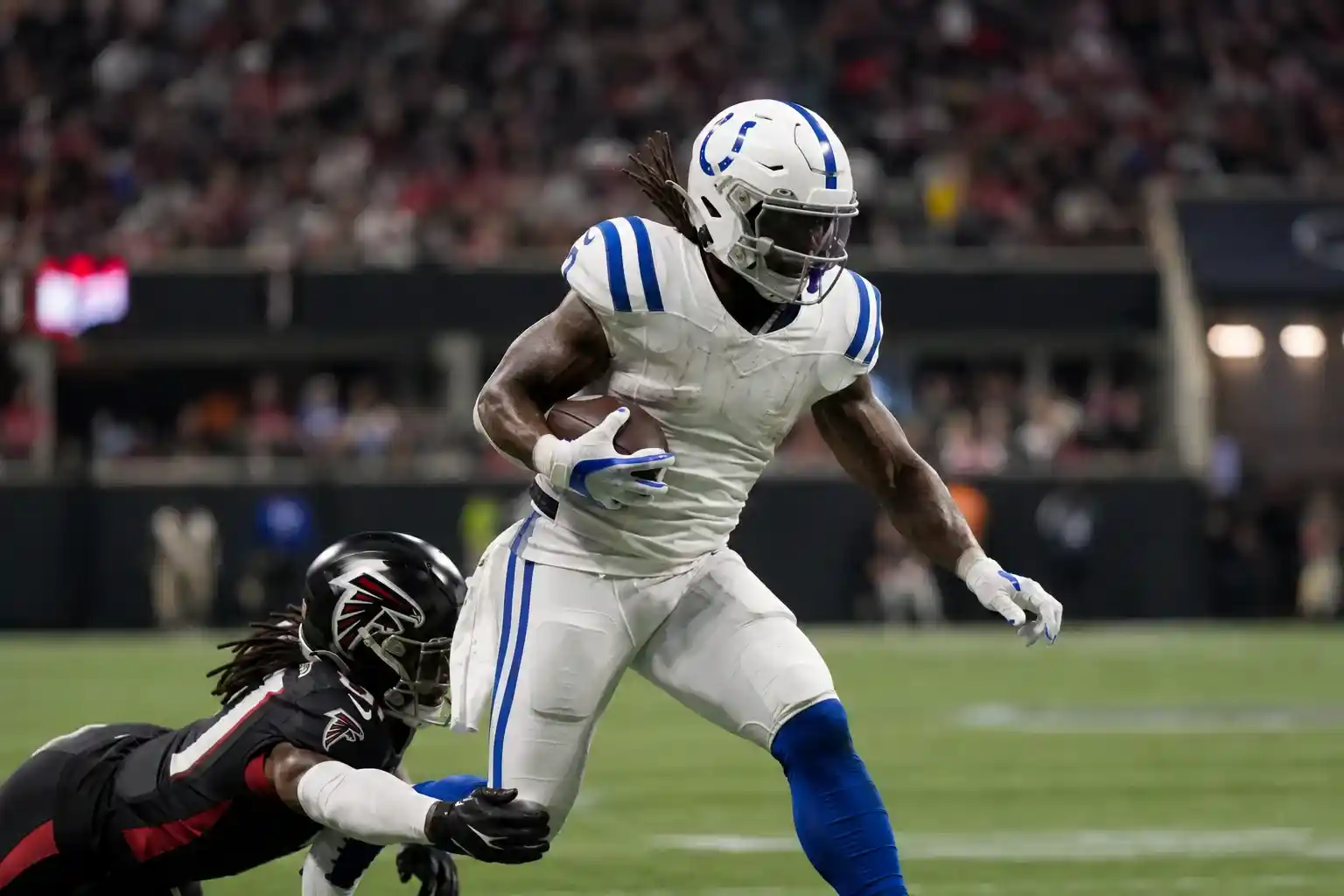
Jonathan Taylor (RB) — 32 carries, 244 yards, 3 touchdowns, 7.6 yards per carry Taylor set new season highs in both carries and rushing yards, breaking off an 83-yard touchdown run and then finishing the job with the game-winning score in overtime. His workload defined the entire Colts offensive game plan.
Daniel Jones (QB) — 19-of-26 passing, 255 yards, 1 touchdown, 1 interception, 100.6 rating Jones distributed the ball efficiently and avoided the mistakes that plagued Atlanta’s passing attack, converting third downs to keep the Colts’ possession-heavy strategy alive.
Tyler Warren (TE) — 8 receptions, 99 yards Warren set a career high in catches, giving Jones a reliable target over the middle throughout the afternoon.
Alec Pierce (WR) — 4 receptions, 84 yards, 1 touchdown, 21.0 yards per catch Pierce provided the explosive element in the Colts’ passing game, averaging over 20 yards per grab and stretching Atlanta’s secondary downfield.
Atlanta Falcons Player Statistics
Michael Penix Jr. (QB) — 12-of-28 passing, 177 yards, 1 touchdown, 0 interceptions Penix avoided turnovers but struggled with accuracy for long stretches, connecting on fewer than half his attempts as Atlanta played from behind most of the game.
Bijan Robinson (RB) — 17 carries, 84 yards, 4.9 yards per carry Robinson was efficient on a per-carry basis but couldn’t match the volume Indianapolis generated on the ground, leaving Atlanta’s offense one-dimensional in crunch time.
Drake London (WR) — 6 receptions, 104 yards, 1 touchdown, 17.3 yards per catch London was Atlanta’s clear top target, topping 100 receiving yards and scoring on a second-quarter touchdown that kept the Falcons within range.
Tyler Allgeier (RB) — 11 carries, 57 yards, 2 touchdowns Allgeier did the dirty work near the goal line, scoring twice, including the go-ahead touchdown in the fourth quarter that briefly put Atlanta on top.
Statistical Leaders Summary
| Category | Atlanta Falcons | Indianapolis Colts |
| Leading Rusher | Bijan Robinson (84 yds) | Jonathan Taylor (244 yds) |
| Leading Passer | Michael Penix Jr. (177 yds) | Daniel Jones (255 yds) |
| Leading Receiver | Drake London (104 yds) | Alec Pierce (84 yds) |
| Most Receptions | Drake London (6 rec) | Tyler Warren (8 rec) |
Why the Colts Won
A Historic Workload for Jonathan Taylor
Feeding Taylor 32 times paid off directly, producing three touchdowns and setting up nearly every long Colts drive of the day.
| Metric | Colts | Falcons |
| Rushing Yards | 323 | 140 |
| Rushing Touchdowns | 3 | 2 |
| Yards Per Carry | 7.9 | — |
Controlling the Clock
Indianapolis held the ball for over 40 minutes, a possession-time advantage of more than 14 minutes that kept Atlanta’s offense off the field for long stretches.
Efficient, Mistake-Free Passing
Jones’s 100.6 rating and single interception-free stretch of drives let the Colts play complementary football instead of forcing throws downfield.
Why the Falcons Lost
Falling Behind Early
Atlanta allowed 13 first-quarter points on a rash of explosive plays, digging a hole that its offense spent the rest of the game trying to climb out of.
Heavy Dependence on One Receiver
Drake London accounted for the majority of Atlanta’s meaningful receiving production, and the rest of the passing game never consistently supplemented his output.
Costly Defensive Lapses
A second-quarter interception thrown by Jones was one of the Falcons’ few takeaways, and missed tackles on several long Colts gains let drives continue that should have stalled.
All-Time Series Context
| Matchup History | Result |
| All-time series | Colts lead 16-3 |
| Most recent meeting before 2025 | Colts victory |
| 2025 result | Colts 31, Falcons 25 (OT) |
Advanced Statistical Insights
Indianapolis’s 7.0 yards-per-play average against Atlanta’s 4.8 tells the real story of this game: the Colts were simply gaining more ground on every snap, which let them control tempo without needing to force big passing plays.
Jonathan Taylor’s 7.6 yards per carry pushed that efficiency even further, meaning Indianapolis rarely faced long down-and-distance situations. On the other side, Atlanta’s offense needed 60 plays to generate 290 yards, a lower per-play return that made every Falcons possession harder work than it needed to be.
Game Implications and Key Lessons
What This Means for the Colts
- The win pushed Indianapolis to 8-2 on the season, keeping them near the top of the AFC South.
- Taylor’s performance reinforced the Colts’ identity as a run-first offense that can win games almost entirely on the ground.
What This Means for the Falcons
- At 3-6, Atlanta’s playoff hopes took another hit, and the loss exposed how much the offense leans on Drake London.
- The Falcons need more consistent quarterback play and a deeper rotation of pass-catching options to stay competitive in close games.
Key Lessons
- Feeding a hot running back can be more valuable than forcing a balanced play-calling script.
- Time of possession still matters when one team can consistently move the chains on the ground.
- A single dominant receiver isn’t enough to overcome a defense that surrenders explosive plays early.
- Interception-free quarterback play often decides close games more than raw passing yardage.
- Overtime performances reward whichever team has the freshest, most reliable playmaker left on the field.
- Missed tackles in the first quarter can define an entire game’s outcome, even if the defense tightens up later.
FAQs
Who won the Colts vs Falcons game?
The Indianapolis Colts won 31-25 in overtime.
What were Jonathan Taylor’s stats in the Colts vs Falcons game?
Taylor rushed 32 times for 244 yards and 3 touchdowns, both season highs.
How many passing yards did Daniel Jones throw for?
Jones completed 19 of 26 passes for 255 yards, 1 touchdown, and 1 interception.
What were Drake London’s receiving stats?
London caught 6 passes for 104 yards and 1 touchdown, leading all Falcons receivers.
Where was the Colts vs Falcons game played?
The game was played at Olympiastadion in Berlin, Germany, in front of 72,203 fans.
Did the Colts vs Falcons game go to overtime?
Yes. Atlanta led late in the fourth quarter before Indianapolis tied the score and won on a Jonathan Taylor touchdown run in overtime.
Conclusion
This game came down to one simple gap: Indianapolis generated more yards on nearly every snap, and Jonathan Taylor turned that advantage into a career day.
Atlanta’s fourth-quarter rally proved the Falcons could compete, but a team offense built around one receiver and a rushing attack that couldn’t keep pace wasn’t enough to finish the job. Efficiency and ball control carried the Colts through overtime, and the full player stat lines above show exactly why.