England vs australia : Clinical Finishing and Midfield Control Powers Lionesses to 3-1 Victory
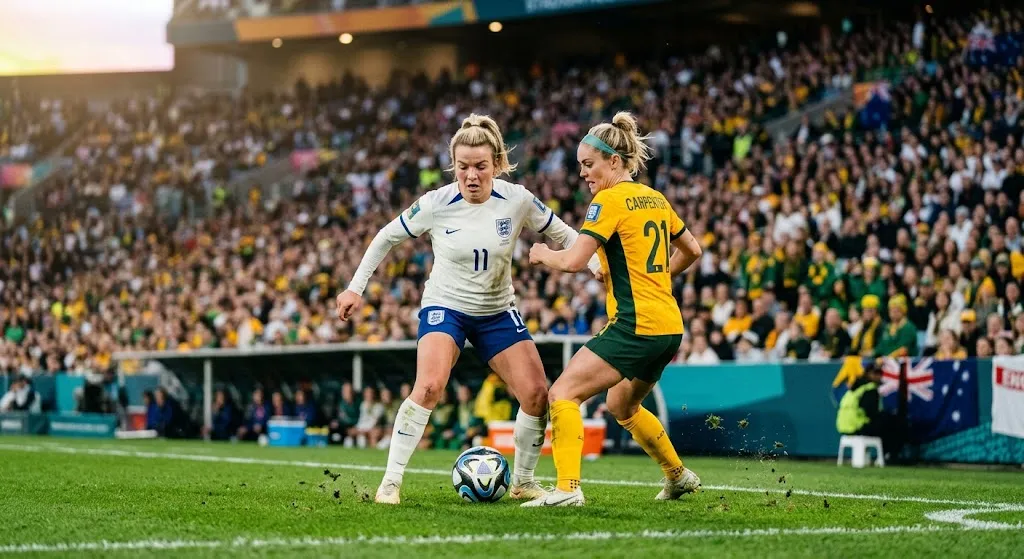
On August 16, 2023, Stadium Australia in Sydney hosted one of the most anticipated international fixtures of the decade. In front of a sell-out crowd of 75,784 fans, England secured a calculated 3-1 victory over co-hosts Australia to book their place in the FIFA Women’s World Cup Final.
England dismantled Australia’s defensive transition through structured midfield control and direct offensive execution. While Australia looked to exploit transitional moments generated by Sam Kerr, England countered with sustained possession, aggressive defensive positioning, and clinical finishing inside the 18-yard box from Ella Toone, Lauren Hemp, and Alessia Russo.
2. Match Overview Table
| Information | Match Details |
| Event | FIFA Women’s World Cup Semi-Final |
| Game | England vs Australia |
| Date | August 16, 2023 |
| Venue | Stadium Australia, Sydney |
| Attendance | 75,784 |
| Winner | England |
| Final Score | 3 – 1 |
| Broadcast | BBC, ITV, Optus Sport, Fox Sports |
3. England vs Australia Match Stats Breakdown
The final team numbers display England’s tactical control across both attacking efficiency and defensive organization.
| Metric | England | Australia |
| Goals | 3 | 1 |
| Expected Goals (xG) | 2.14 | 1.28 |
| Total Shots | 15 | 12 |
| Shots on Target | 5 | 4 |
| Possession (%) | 59% | 41% |
| Accurate Passes | 392 (81%) | 244 (71%) |
| Big Chances Created | 4 | 2 |
| Tackles Won | 18 (75%) | 14 (64%) |
| Interceptions | 11 | 8 |
| Corners | 6 | 4 |
| Fouls Committed | 9 | 11 |
Expected Goals and Shot Conversion
England produced 2.14 xG compared to Australia’s 1.28, reflecting better scoring positions inside the penalty box.
The Lionesses placed 60% of their shots on target into the back of the net, capitalizing directly on Australian defensive breakdowns.
Midfield Ball Retention and Passing Accuracy
England dictated the match tempo with 59% possession, completing 392 accurate passes at an 81% success rate to suppress Australian counter-attacks.
Australia managed only a 71% passing accuracy, repeatedly turning over the ball under England’s coordinated midfield press.
Defensive Duel Efficiency
England won 75% of their attempted tackles, shutting down attacking wide channels and preventing cutbacks.
Australia struggled to clear contested balls inside their defensive third, handing England repeated second-chance opportunities.
4. Period-by-Period Analysis
First Half Analysis
| Period | England Score | Australia Score |
| First Half (1′ – 45+2′) | 1 | 0 |
Opening Physicality (1′ – 25′): England established an aggressive physical presence early, disrupting Australia’s build-up with disciplined pressing and immediate ball recovery.
Toone’s Breakthrough (36′): Following sustained wide pressure down the left flank, Alessia Russo cut the ball back to Ella Toone, who struck a first-time shot into the top-right corner.
Australian Containment (37′ – 45′): Australia pushed forward looking for an equalizer before the interval, but England’s backline restricted them to low-percentage attempts from outside the penalty area.
Second Half Analysis
| Period | England Score | Australia Score |
| Second Half (46′ – 90+6′) | 2 | 1 |
Kerr’s Equalizer (63′): Sam Kerr collected the ball inside her own half, drove directly toward England’s retreating defense, and unleashed a 25-yard dipping strike past Mary Earps to level the score.
Hemp Capitalizes (71′): Australia’s parity lasted only eight minutes before a long ball over the top created confusion in the Matildas’ box, allowing Lauren Hemp to slip a finish past Mackenzie Arnold.
Russo’s Dagger (86′): As Australia committed numbers forward searching for another equalizer, Lauren Hemp executed a reverse through-ball to Alessia Russo, who drove an angled strike into the bottom corner.
5. England vs Australia Player Stats: Key Performers Analyzed
| Player | Team | Position | Rating / 10 | Primary Performance Line |
| Lauren Hemp | England | Forward | 9.1 | Three crucial passes, four dribbles, one goal, and one assist |
| Alessia Russo | England | Forward | 8.6 | 1 Goal, 1 Assist (Action), 4 Shots, 5 Aerial Duels |
| Ella Toone | England | Midfielder | 8.2 | 1 Goal, 88% Pass Accuracy, 2 Interceptions |
| Georgia Stanway | England | Midfielder | 7.9 | 42 Passes, 5 Tackles, 8 Ball Recoveries |
| Sam Kerr | Australia | Forward | 7.8 | 4 shots, 2 on target, 1 goal |
| Katrina Gorry | Australia | Midfielder | 7.2 | 6 Tackles Won, 3 Interceptions, 47 Touches |
| Mary Fowler | Australia | Forward | 6.8 | 2 Key Passes, 3 Dribbles, 74% Pass Accuracy |
England Player Statistics
Lauren Hemp (Forward)
Stats: 1 Goal, 1 Assist, 3 Key Passes, 4 Successful Dribbles, 3 Tackles Won
Hemp led England’s frontline with tireless running, forcing a major defensive error for her goal before providing the vision and pass on Russo’s clincher.
Alessia Russo (Forward)
Stats: 1 Goal, 1 Assist (Shot Creation Action), 4 Shots (2 on Target), 5 Aerial Duels Won
Russo gave England an essential physical focal point, holding up play against central defenders and finishing with authority in the 86th minute.
Ella Toone (Midfielder)
Stats: 1 Goal, 88% Pass Accuracy, 2 Interceptions, 1 Key Pass
Toone found pockets of space between Australia’s midfield lines, breaking the deadlock with a clean, high-velocity strike into the top corner.
Georgia Stanway (Midfielder)
Stats: 42 Completed Passes, 5 Tackles, 8 Ball Recoveries, 2 Fouls Drawn
Stanway anchored the middle third, shutting down passing lanes into Kerr and winning second balls to keep England on the attack.
Australia Player Statistics
Sam Kerr (Forward)
Stats: 1 Goal, 4 Shots (2 on Target), 0.62 xG, 3 Aerial Duels Won
Kerr displayed world-class individual quality on her long-range goal, but lacked consistent service across the 90 minutes.
Katrina Gorry (Midfielder)
Stats: 6 Tackles Won, 3 Interceptions, 47 Touches, 1 Key Pass
Gorry battled relentlessly in central midfield, breaking up multiple English attacks despite dealing with an overloaded center of the pitch.
Mary Fowler (Forward/Midfielder)
Stats: 2 Key Passes, 74% Pass Accuracy, 3 Dribbles Completed, 1 Shot
Fowler offered creative flashes in attacking transition, though England’s backline quickly crowded her whenever she approached the box.
6. Statistical Leaders Summary Table
| Category | England | Australia |
| Leading Scorer | Ella Toone, Lauren Hemp, Alessia Russo (1) | Sam Kerr (1) |
| Second Leading Scorer / Shot Creator | Lauren Hemp (1 Goal, 1 Assist) | Mary Fowler (2 Key Passes, 0.35 xA) |
| Top Defensive Impact | Alex Greenwood (8 Interceptions/Tackles) | Katrina Gorry (6 Tackles Won, 3 Interceptions) |
| Most Assists / Playmaker | Lauren Hemp (1 Assist, 3 Key Passes) | Katrina Gorry (1 Assist Action) |
7. Analytical Breakdowns (“Why They Won / Why They Lost”)
Why England Won
Dominance in Transition Defense
England anticipated Australia’s counter-attacking strategy, assigning Lucy Bronze and Alex Greenwood to step up immediately whenever possession changed hands.
| Defensive Action Metric | England | Australia |
| Interceptions in Midfield Third | 7 | 3 |
| Defensive Ball Recoveries | 54 | 42 |
| Tackles in Middle Third | 9 | 4 |
Overloading Half-Spaces
Sarina Wiegman’s tactical setup positioned forwards and attacking midfielders in the channels between Australia’s full-backs and central defenders, repeatedly destabilizing their back four.
England executed 14 crosses into the box at a 35% completion rate.
Russo and Hemp dragged defenders toward the flanks, creating open cutback lanes for late-arriving midfield runners.
Clinical Finishing Under Pressure
England capitalized on high-value chances, converting 3 of their 5 shots on target into goals and exceeding their baseline xG value by +0.86.
Why Australia Lost
Defensive Communication Breakdowns
Australia conceded the decisive second goal due to miscommunication between defender Ellie Carpenter and goalkeeper Mackenzie Arnold during a routine bouncing-ball sequence.
| Defensive Breakdown Phase | Action Taken | Tactical Consequence |
| 71st Minute Long Ball | Carpenter failed to clear cleanly | Lauren Hemp stole possession inside the 6-yard box |
| 86th Minute Transition | Backline stepped forward inconsistently | Russo found open space in the right channel to score |
Over-Reliance on Sam Kerr in Isolation
Australia directed 48% of their forward passes toward Kerr, leaving their attacking phases predictable.
A review of the england vs australia box score shows that Australia managed only 2 total shots inside the penalty box from players other than Kerr and Fowler.
8. Historical Context & Advanced Insights
Recent Head-to-Head Encounters
| Date | Competition | Result | Key Match Metric |
| August 16, 2023 | FIFA Women’s World Cup Semi-Final | England 3 – 1 Australia | England 59% Possession |
| April 11, 2023 | International Friendly | Australia 2 – 0 England | Australia 3 Shots on Target, 2 Goals |
| October 9, 2018 | International Friendly | England 1 – 1 Australia | Late Australian Equalizer (84′) |
Advanced Metric Breakdown: Passes Per Defensive Action (PPDA)
England’s pressing intensity limited Australia’s ability to build out from the back. The data highlights England’s aggressive defensive posture compared to Australia’s mid-block stance.
| Advanced Metric | England | Australia |
| PPDA (Pressing Intensity – Lower = More Aggressive) | 8.4 | 14.2 |
| Field Tilt (% of Final Third Passes) | 61.8% | 38.2% |
| Non-Penalty xG per Shot | 0.14 | 0.10 |
England operated with a PPDA of 8.4 in Australia’s half, forcing turnovers that kept the Matildas pinned inside their defensive territory for large stretches.
9. Game Implications & Key Lessons
What This Means for England
Historic Final Berth: The Lionesses reached their first-ever FIFA Women’s World Cup Final.
Tactical Resilience: Proved they can execute an aggressive possession plan in front of a hostile away crowd.
Balanced Scoring: Showed that their attacking threat is distributed across multiple positions rather than concentrated on one striker.
What This Means for Australia
Roster Depth Needs: Demonstrated the need for more creative central playmakers to support dynamic frontlines.
Tournament Benchmark: Validated their status as a global contender despite falling short in key defensive moments.
Key Lessons from the Match
Structured ball retention prevents dynamic counter-attacking teams from finding rhythm.
Star individual goals provide temporary momentum, but organized team pressing wins knockout fixtures.
Miscommunications in the defensive 18-yard box are punished instantly at the highest international level.
Exploiting half-spaces creates higher-percentage scoring chances than repetitive wide crossing.
Managing game tempo after conceding shifts pressure back onto the trailing opponent.
Final Match Synthesis: Structured Execution Over Individual Moments
Reviewing the game tape and data makes it clear that England’s structured setup and execution outmatched Australia’s moments of individual skill. While Sam Kerr delivered an extraordinary strike to level the match, England’s collective pressing, superiority in midfield duels, and sharp finishing in the final third earned them a commanding 3-1 victory.