New Orleans Saints vs Los Angeles Rams Match Player Stats: Stetson Bennett’s Dual-Threat Masterclass Leads Rams to 34-0 Preseason Shutout
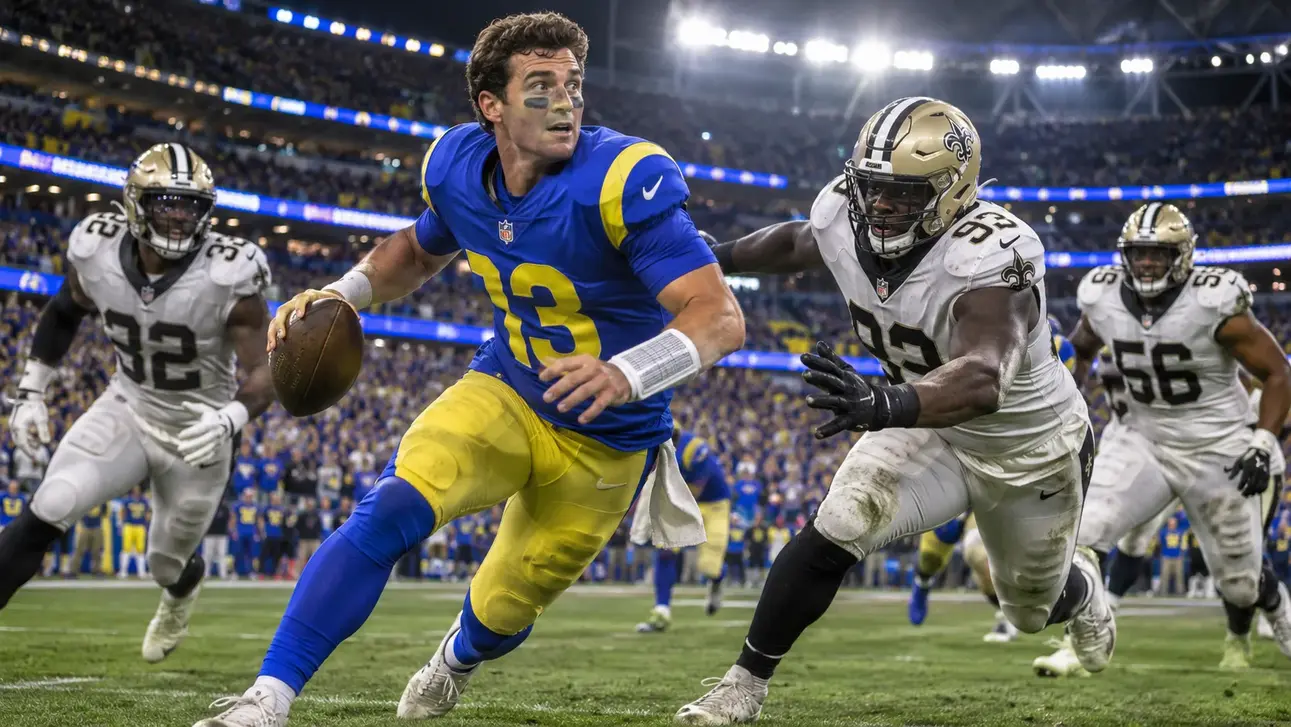
The New Orleans Saints vs Los Angeles Rams match player stats reveal a lopsided preseason affair where quarterback depth and defensive discipline told the entire story. On a scorching August evening at SoFi Stadium, the Rams systematically dismantled the Saints, turning a competitive first quarter into a rout through efficient quarterback play and a back-breaking 100-yard interception return. The final score of 34-0 reflects a game where Los Angeles controlled both sides of the line of scrimmage, leaving New Orleans with significant questions to answer before the regular season begins.
Match Overview Table
| Information | Match Details |
| Event | NFL Preseason Week 2 |
| Game | New Orleans Saints vs Los Angeles Rams |
| Date | August 22, 2026 |
| Venue | SoFi Stadium, Inglewood, CA |
| Attendance | 71,206 |
| Winner | Los Angeles Rams |
| Final Score | 34-0 |
| Broadcast | NFL Network / Local Affiliates |
Core Match Statistics Overview
The team stats table paints a picture of complete Los Angeles dominance, particularly in possession and turnover margins. The Saints moved the ball sporadically but failed to finish drives, while the Rams capitalized on short fields and defensive scores.
| Metric | New Orleans Saints | Los Angeles Rams |
| Total Yards | 293 | 405 |
| Passing Yards | 188 | 254 |
| Rushing Yards | 105 | 151 |
| First Downs | 13 | 28 |
| Turnovers | 3 | 0 |
| Penalties | 12-96 | 7-60 |
| Possession Time | 28:12 | 31:48 |
| Red Zone Efficiency | 0-2 | 3-5 |
Third Down Efficiency and Drive Sustainability
The Saints converted 7 of 16 third downs, a respectable figure that masks their inability to produce points. The Rams, however, converted 7 of 13 and consistently moved the chains when it mattered, largely because Stetson Bennett managed the game with poise and found open receivers on scramble drills.
Turnover Margin as the Great Equalizer
New Orleans turned the ball over three times, including two interceptions and a lost fumble. The Rams, by contrast, played a clean game with zero giveaways. The most devastating blow was Spencer Rattler’s third-quarter interception, which Alex Cook returned 100 yards for a touchdown—a 14-point swing in a game where the Saints were already struggling to cross midfield .
Period-by-Period Analysis
First Quarter
| Team | Q1 Score |
| Saints | 0 |
| Rams | 3 |
The opening frame was a field-position battle, with the Rams managing only a 26-yard Harrison Mevis field goal after a methodical 14-play drive.- New Orleans’ defense held firm in the red zone, forcing the short kick, but the offense managed just 22 total yards in the quarter.
- The Saints’ inability to sustain drives immediately put their defense in unfavorable situations, setting the tone for the evening.
Second Quarter
| Team | Q2 Score |
| Saints | 0 |
| Rams | 17 |
Stetson Bennett took over the game with two rushing touchdowns from 1 and 8 yards out, showcasing his mobility in goal-line situations .- A late Harrison Mevis field goal extended the lead to 20-0 at halftime, a deficit that already felt insurmountable given the Saints’ offensive stagnation.
- The Rams’ 17-point quarter was built on 11-play and 9-play drives, demonstrating their ability to sustain long possessions and wear down the Saints’ defensive front.
Third Quarter
| Team | Q3 Score |
| Saints | 0 |
| Rams | 7 |
The defining moment of the game occurred early in the third when Spencer Rattler’s short middle pass was intercepted by Alex Cook, who returned it 100 yards for a touchdown .- That play effectively ended any faint hope of a New Orleans comeback, pushing the score to 27-0.
- The Saints’ offense managed only 5 passing yards in the quarter, as the Rams’ secondary tightened coverage and Rattler’s confidence visibly waned.
Fourth Quarter
| Team | Q4 Score |
| Saints | 0 |
| Rams | 7 |
Jarquez Hunter capped the scoring with a 12-yard touchdown run, finishing a 11-play, 66-yard drive that consumed over five minutes of clock .- Ty Simpson, relieving Bennett, completed four passes on the scoring drive, including a 24-yard connection with Dan Villari to set up the score .
- The Saints’ final possessions ended in a punt and a turnover on downs, sealing their second preseason loss.
Detailed Team Player Statistics
New Orleans Saints Player Statistics
Spencer Rattler (QB)
| Stat | Value |
| Completions/Attempts | 14/23 |
| Passing Yards | 141 |
| Touchdowns | 0 |
| Interceptions | 1 |
| Rating | 60.2 |
Rattler showed flashes of competence in the short passing game but never threatened the Rams vertically. His interception return for a touchdown was a fatal error that erased any momentum the Saints might have built.
CJ Donaldson (RB/WR)
| Stat | Value |
| Receptions | 4 |
| Receiving Yards | 51 |
| Long | 32 |
| Rushing Yards | 15 |
Donaldson was the Saints’ most productive offensive weapon, creating chunk plays in the passing game that the rest of the roster could not match. His 32-yard reception was New Orleans’ longest play from scrimmage.
Moliki Matavao (TE)
| Stat | Value |
| Receptions | 3 |
| Receiving Yards | 34 |
| Targets | 3 |
Matavao provided a reliable underneath option for Rattler, converting all three of his targets. However, his contributions came in between the 20s and never translated into scoring opportunities.
Los Angeles Rams Player Statistics
Stetson Bennett (QB)
| Stat | Value |
| Completions/Attempts | 19/31 |
| Passing Yards | 181 |
| Rushing Yards | 29 |
| Rushing Touchdowns | 2 |
| Interceptions | 0 |
Bennett’s command of the offense was the story of the game. He extended plays with his legs when the pocket collapsed and converted critical third downs. His two rushing touchdowns demonstrated the red-zone versatility that the Saints simply could not defend .
Jarquez Hunter (RB)
| Stat | Value |
| Carries | 12 |
| Rushing Yards | 68 |
| Yards per Carry | 5.7 |
| Touchdowns | 1 |
Hunter’s fresh legs in the fourth quarter put the game away, but his efficiency throughout the evening kept the Rams ahead of the chains. His 12-yard scoring run was a display of patience and burst through the left side.
CJ Daniels (WR)
| Stat | Value |
| Receptions | 8 |
| Receiving Yards | 68 |
| Long | 17 |
Daniels was Bennett’s security blanket, hauling in eight of his targets for consistent gains. His ability to find soft spots in the Saints’ zone coverage moved the chains repeatedly on scoring drives.
Alex Cook (DB)
| Stat | Value |
| Interceptions | 1 |
| Return Yards | 100 |
| Touchdowns | 1 |
Cook’s 100-yard interception return was the dagger. Reading Rattler’s eyes perfectly, he jumped the short middle route and outran the Saints’ offense to the end zone, turning a competitive game into a blowout .
Statistical Leaders Summary Table
| Category | New Orleans Saints | Los Angeles Rams |
| Leading Scorer | N/A (0 points) | Stetson Bennett (12 points) |
| Second Leading Scorer | N/A | Harrison Mevis (8 points) |
| Top Rusher | K. Miller (26 yards) | Jarquez Hunter (68 yards) |
| Most Receptions | CJ Donaldson (4) | CJ Daniels (8) |
| Leading Passer | Spencer Rattler (141 yards) | Stetson Bennett (181 yards) |
Analytical Breakdowns
Why the Los Angeles Rams Won
Turnover-Free Football and Defensive Scoring
The Rams’ zero-turnover performance was the foundational advantage. While the Saints gifted three possessions via turnovers, Los Angeles protected the ball and allowed their defense to dictate terms. Alex Cook’s pick-six wasn’t merely a bonus; it was the direct result of a defensive scheme that baited Rattler into a predictable read.
| Team | Turnovers | Points Off Turnovers |
| Saints | 3 | 0 |
| Rams | 0 | 14 |
Red Zone Efficiency and Goal-Line Creativity
Los Angeles converted 3 of 5 red-zone opportunities, with Bennett’s two rushing touchdowns highlighting their willingness to use the quarterback as a runner near the goal line. The Saints, by contrast, went 0-for-2 in the red zone, failing to convert a single trip inside the 20 into points.
| Team | Red Zone Conversions | Red Zone Percentage |
| Saints | 0/2 | 0% |
| Rams | 3/5 | 60% |
Quarterback Play and Drive Extension
Bennett’s ability to scramble and extend plays kept the Rams ahead of schedule. His 29 rushing yards and two scores forced the Saints’ defense to account for him on every snap, opening throwing lanes for Daniels and the tight ends.
| Metric | Bennett | Rattler |
| Completion % | 61.3% | 60.9% |
| Rushing Yards | 29 | 17 |
| Rushing TDs | 2 | 0 |
| Interceptions | 0 | 1 |
Why the New Orleans Saints Lost
Inability to Finish Drives
The Saints moved the ball adequately between the 20s, accumulating 293 total yards, but their red-zone failures were absolute. Two trips inside the Rams’ 20 produced zero points, a deficiency that kept the game scoreless on their side and allowed Los Angeles to pull away incrementally.
Penalty Discipline and Negative Plays
Twelve penalties for 96 yards repeatedly put the Saints behind the sticks. Several of these flags came on third down or extended Rams drives, compounding the damage of their turnovers. In a game where they needed every advantage, New Orleans consistently hurt themselves with preventable mistakes.
Quarterback Pressure and Decision-Making
While the Rams recorded only one sack, they hurried Rattler on several throws and forced him into off-platform decisions. His interception was the most visible consequence, but several other throws were nearly intercepted or thrown into tight windows that a more experienced defense would have punished.
Historical Context & Advanced Insights
This matchup was a preseason contest, so a season series breakdown is limited to this single exhibition. However, the game carries broader significance for both franchises’ evaluation processes.
Advanced Statistical Insights
The most telling advanced metric is yards per play. The Rams averaged 5.5 yards per play compared to the Saints’ 4.7, a gap that reflects both Los Angeles’ superior efficiency and New Orleans’ inability to generate explosive plays. The Saints managed only one play over 30 yards (Donaldson’s 32-yard reception), while the Rams consistently picked up chunks of 8-12 yards through the air and on the ground.
The assist-to-touchdown ratio tells a similar story. The Rams’ 27 completions produced three rushing touchdowns and four scoring drives, while the Saints’ 20 completions yielded zero touchdowns. Efficiency in the red zone, not volume between the 20s, decided this game.
Game Implications & Key Lessons
What This Means for the Rams
- Stetson Bennett’s dual-threat performance solidifies his case for a roster spot or practice squad elevation, giving the coaching staff confidence in their quarterback depth.
- The defense’s zero-turnover, three-takeaway performance demonstrates the scheme’s potential when the front seven generates pressure without blitzing.
- A 2-0 preseason start provides momentum, though the real evaluation begins when starters see extended snaps.
What This Means for the Saints
- Spencer Rattler’s interception and inability to finish drives raise questions about his readiness, even in a backup role.
- The red-zone offense requires immediate schematic attention; going 0-for-2 in a preseason game suggests systemic issues rather than isolated execution errors.
- Penalty discipline must be addressed before the regular season, as 12 flags for 96 yards is a recipe for losing close games.
Key Lessons
- Turnover margin remains the most reliable predictor of preseason outcomes, even when starters play limited snaps.
- A quarterback who can run for touchdowns in the red zone changes defensive calculus entirely.
- Defensive scores are momentum killers; the 100-yard interception return was worth more than seven points in psychological terms.
- Red-zone efficiency separates competitive teams from pretenders.
- Penalty discipline is a coaching issue, not a player issue, and requires immediate correction.
- Preseason depth charts are written in pencil; Bennett’s performance may force a reevaluation.
FAQs
Who won the Saints vs Rams preseason game?
The Los Angeles Rams defeated the New Orleans Saints 34-0 on August 22, 2026, at SoFi Stadium .
Who scored the most points in the Saints vs Rams game?
Stetson Bennett scored two rushing touchdowns (12 points), while Harrison Mevis added two field goals and four extra points. Alex Cook added a defensive touchdown .
What were Stetson Bennett’s stats against the Saints?
Bennett completed 19 of 31 passes for 181 yards, rushed for 29 yards, and scored two rushing touchdowns with no interceptions .
How many yards did Spencer Rattler throw for?
Spencer Rattler completed 14 of 23 passes for 141 yards with zero touchdowns and one interception .
What was the turnover differential in the Saints vs Rams game?
The Rams had zero turnovers, while the Saints committed three (two interceptions, one lost fumble) .
How did the Rams score their final touchdown?
Jarquez Hunter rushed for a 12-yard touchdown in the fourth quarter to cap an 11-play, 66-yard drive .
Conclusion
The New Orleans Saints vs Los Angeles Rams match player stats reveal a game decided by efficiency, discipline, and quarterback play. Stetson Bennett’s ability to avoid turnovers while creating scoring opportunities with his legs gave the Rams an offensive dimension the Saints could not match. Meanwhile, New Orleans’ red-zone failures and three turnovers turned a manageable deficit into a blowout. For the Rams, the 34-0 victory is a confidence booster built on complementary football. For the Saints, it is a stark reminder that moving the ball between the 20s means little without execution in the moments that decide games.